
Hunger vs Cravings: How to Tell the Difference Fast

Physical hunger builds gradually and asks for calories in general. A craving hits fast and demands one specific food, usually something salty, sweet, or fried. The fastest way to tell them apart: pause for 10 to 20 minutes, rate your hunger on a 1 to 10 scale, and then decide.
Here are the three-step actions you can use the next time an urge shows up, whether it’s 3 p.m. at your desk or 9 p.m. on the couch:
Pause. Set a timer for 10 to 20 minutes before you eat anything. If the urge is a craving, it often fades or softens during this window, according to a diagnostic approach described by University of Michigan researchers.
Assess on the hunger gauge. Rate your hunger from 1 (starving, shaky) to 10 (uncomfortably stuffed). A true physical need usually sits at 3 or 4.
Choose your response. If you’re still at a 3 or 4 after the pause, eat a balanced snack or meal. If the urge weakened or disappeared, it was likely a craving, and you can redirect your attention.
Here’s what that looks like in practice: you finish dinner, then suddenly want chocolate. You wait 10 minutes and drink a glass of water. If you’re still thinking about chocolate afterward and your stomach feels genuinely empty, have a small piece and move on. If the thought has faded, it wasn’t hunger. It was your brain’s reward system talking, not your stomach.
Pro Tip: Keep a sticky note on your fridge or a reminder in your phone that just says “Pause 10.” That single visual cue interrupts the automatic reach for food long enough for your brain to catch up with your body.
Key Takeaways
Physical hunger builds gradually and needs food; cravings hit suddenly, target a specific food, and usually fade with a short pause.
Point | Details |
Use the pause rule | Wait 10 to 20 minutes before eating when you’re unsure if it’s hunger or a craving. |
Rate your hunger | Use the 1 to 10 hunger scale and aim to eat around a 3 or 4, not lower. |
Eat on a schedule | Consistent meals with protein, fat, and fiber reduce how often cravings appear. |
Plan tempting foods | Pre-approving a treat removes its “forbidden” pull and makes cravings easier to manage. |
Watch for red flags | Bingeing, loss of control, or craving non-food items warrant a conversation with a professional. |
Track your patterns | Journal hunger and craving triggers for one to two weeks to spot what’s really driving them. |
Table of Contents
Hunger vs Cravings: What Physical Hunger Actually Feels Like
Physical hunger is your body’s signal that it needs fuel, driven by a hormone called ghrelin that rises in your stomach and signals your brain when your last meal has been digested. As your stomach empties, ghrelin increases and leptin, the hormone that signals fullness, drops. Your body isn’t being dramatic. It’s running a chemical countdown.
True hunger shows up through physical cues that are hard to argue with:
A hollow, rumbling, or gnawing sensation in your stomach
Low energy or trouble concentrating
Mild irritability or a headache that builds slowly
Lightheadedness if you’ve gone especially long without eating
A general willingness to eat almost anything, not just one specific food
Most people start feeling genuine hunger a few hours after a meal, though that timing shifts depending on what you ate. A breakfast heavy in protein and fiber, like eggs with vegetables, holds you longer than a bowl of sugary cereal. Meal composition changes the timeline more than most people realize.
Hunger and satiety are governed by a network of gut-brain signals, hormonal shifts, and reward circuitry in the brain, according to a physiological review published in the New England Journal of Medicine. Restrictive dieting disrupts this system and tends to make cravings harder to manage, not easier.
Learning to recognize these signals is the foundation of hunger management. Once you know what real hunger feels like in your body, everything else about telling it apart from a craving gets easier.
What Food Cravings Are and Why They Feel So Strong
A craving is an intense desire for one specific food, not a general need for calories. You don’t crave “food.” You crave pizza, ice cream, or salty chips, and usually nothing else will satisfy that pull.

Common cravings tend to cluster around a few categories: chocolate, ice cream, French fries, chips, and bread. These foods share a pattern. They’re calorie-dense, often high in sugar, fat, or salt, and they hit the brain’s reward pathways hard. That’s not a character flaw. It’s basic neuroscience, and it’s estimated that a very large majority of people experience food cravings at some point.
Cravings are driven by psychology and environment far more than by empty-stomach biology.
Stress raises cortisol, which can increase appetite for high-fat, high-sugar foods.
Boredom creates a mental itch that food conveniently scratches, even without any physical need.
Sensory cues like the smell of fresh bread or an ad for a burger chain can trigger a craving out of nowhere.
Low dopamine states, including fatigue or a flat mood, push people toward food as a quick reward, a pattern Scripps Health outlines among common craving triggers.
Strict dieting makes all of this worse. When you cut out entire food groups or slash calories too aggressively, your brain fixates on the exact foods you’re avoiding, according to research on cognitive strategies for craving management. The more forbidden a food feels, the louder the craving gets. This is one reason Coachjillbyrne builds coaching plans around balance instead of elimination. Restriction backfires more often than it succeeds.
How to Tell if It’s Hunger or a Craving
Run the urge through the hunger scale first, then a fast checklist if you’re still unsure. Between the two, you’ll have your answer in under a minute.
The Hunger and Fullness Scale, used by health systems including Kaiser Permanente and Johns Hopkins Medicine, gives you numeric language for a feeling that’s usually vague:
Hunger Level | What It Feels Like | What to Do |
1-2 | Starving, shaky, headache, can’t focus | Eat as soon as possible; avoid reaching this point |
3-4 | Clearly hungry, stomach empty, ready to eat | Ideal time to eat a balanced meal or snack |
5-6 | Comfortably satisfied, no longer thinking about food | Good stopping point; no need to keep eating |
7-8 | Full, slightly uncomfortable | Stop eating; wait before considering more food |
9-10 | Uncomfortably stuffed, sluggish | Overeating has occurred; note the trigger for next time |
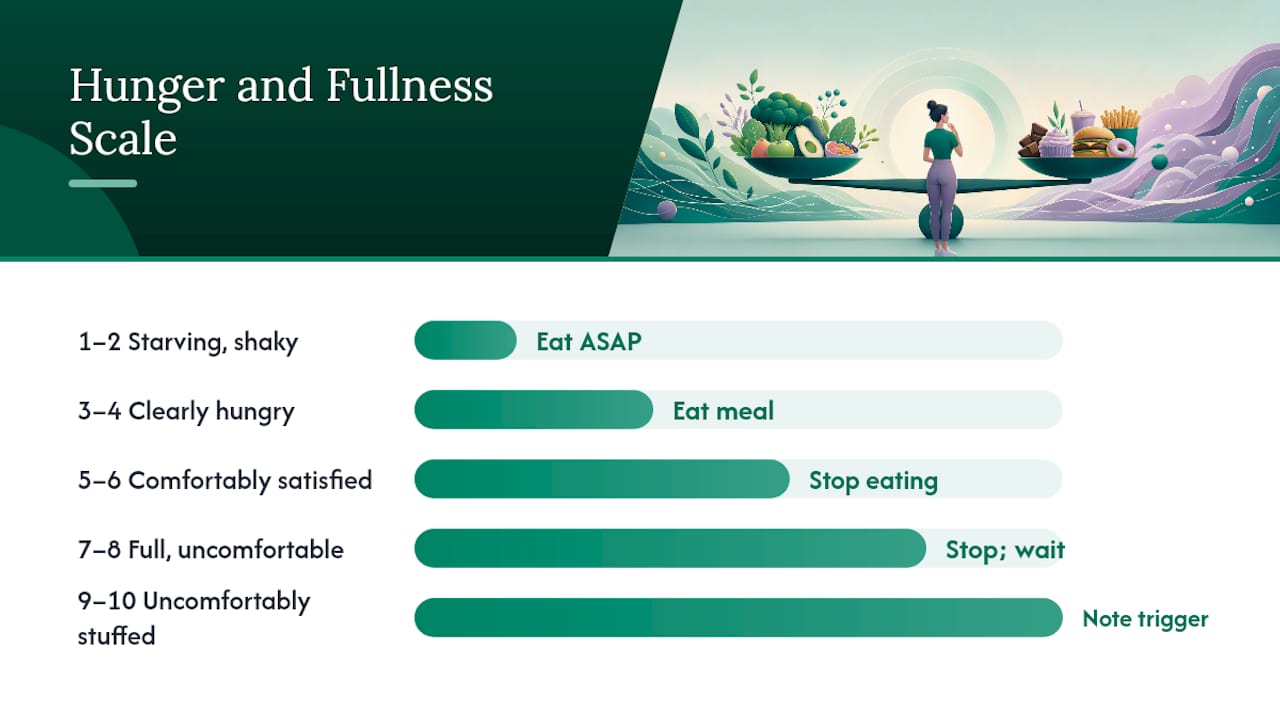
The American Diabetes Association recommends starting meals around a 3 or 4 and stopping around a 5 or 6, which avoids both the extreme hunger that leads to overeating and the discomfort of eating past fullness.
If your number lands in a gray zone, run through this six-question checklist:
Is the urge for one specific food, or would any meal satisfy you?
Did you eat within the last two hours?
Is your energy noticeably low?
Would the urge fade if you got distracted for 20 minutes?
Are you stressed, bored, or tired right now?
Does your stomach feel physically empty?
Two quick examples show how this plays out. Someone who hasn’t eaten in five hours, feels shaky, and would happily eat a salad, chicken, or leftovers is dealing with true hunger. Someone who just finished lunch but suddenly wants a specific candy bar after seeing a coworker eating one is dealing with a craving, and the mitigation is delay, not food.
What Turns Ordinary Appetite Into a Strong Craving
Six triggers show up again and again in both clinical research and coaching sessions: stress, poor sleep, dehydration, environmental cues, learned habits, and restrictive dieting.
Stress and cortisol. Chronic stress raises cortisol levels, which increases appetite, particularly for high-sugar and high-fat foods. Mitigation: a two-minute breathing exercise before eating often blunts the urge enough to make a clearer choice.
Sleep loss. Poor sleep disrupts ghrelin and leptin balance, making you hungrier and less able to resist cravings the next day. Mitigation: protect a consistent sleep window, even an extra 30 minutes matters.
Dehydration. Thirst is frequently misread as hunger because the signals overlap in the brain. Mitigation: drink a full glass of water and wait 10 minutes before deciding you’re hungry.
Environmental cues. Ads, smells, and even the sight of a snack aisle can trigger cravings with no physical hunger involved, a pattern documented by [Scripps Health](https://www.scripps.org/news_items/6147-7-tips-to-control-your food-cravings). Mitigation: keep tempting foods out of immediate sight at home and work.
Learned habits. If you always eat popcorn during a movie or chips while watching the news, your brain links the activity to the food. Mitigation: swap the activity cue, like sitting in a different chair, to break the automatic link.
Restrictive dieting. Cutting entire food groups increases fixation on those exact foods, an effect outlined in research on outsmarting food cravings from UCSD. Mitigation: build small, planned portions of favorite foods into your week instead of banning them outright.
Understanding emotional triggers in general, not just food-related ones, can also help you separate what you’re actually feeling from what you’re reaching for. Mastering Conflict’s breakdown of emotional triggers is a useful reference for anyone who notices stress or frustration consistently precedes a craving.
What to Do When It’s Hunger vs What to Do When It’s a Craving
Hunger needs food. Cravings need a delay, a substitution, or a small planned portion. Treating both the same way is where most people get stuck, either ignoring real hunger until they overeat later, or giving in to every craving out of fear of “denying” themselves.
For real hunger, aim for a plate or snack with protein, fat, and fiber together, since that combination extends satiety longer than carbohydrates alone, according to guidance on decoding food cravings from Ohio State Health & Discovery. Two examples:
Greek yogurt with berries and a tablespoon of almond butter
A hard-boiled egg, a small handful of nuts, and a piece of fruit
For a craving, try the “surf the urge” protocol, a technique borrowed from urge-management therapy:
Name it. Say silently, “This is a craving for chocolate, not hunger.”
Breathe. Take five slow breaths, in for four counts, out for six.
Wait. Set a timer for 10 to 20 minutes and do something else.
Recheck. Rate your hunger again. If it’s still there and you’re at a 3 or 4, eat something balanced. If the urge faded, let it pass.
Reflect. Note what triggered it, so the pattern becomes easier to spot next time.
A few daily habits reduce how often you’re caught off guard by a craving in the first place:
Eat on a consistent schedule, whether that’s three meals plus one snack or two larger meals plus a snack
Drink water before assuming you’re hungry
Protect seven to nine hours of sleep
Keep a portable, balanced snack with you (nuts, jerky, a piece of fruit)
Plan for your favorite tempting foods instead of pretending they don’t exist
Pro Tip: If you know Friday night pizza is your thing, schedule it. Put it on the calendar, plan the portion, and enjoy it without guilt. Foods you’ve pre-approved lose most of their power to derail you, because the “forbidden” charge is gone. This kind of planned-indulgence approach is a core piece of what Coachjillbyrne teaches. in mindful nutrition coaching, and it works better long term than white-knuckling through restriction.
What the Research Says About Managing Cravings
Cognitive strategies measurably reduce how much people eat when a craving hits. In one controlled study, people trained in specific cognitive techniques to manage cravings consumed significantly fewer calories in taste tests compared to people given no training at all. That’s a meaningful data point: managing a craving isn’t just willpower, it’s a skill that responds to practice.
“Hunger and cravings are shaped by gut-brain signaling, reward circuitry in the brain, and the degree of cognitive control a person can exercise in the moment,” according to the Obesity Action Coalition, which also notes that restrictive dieting makes that control harder to maintain.
In coaching practice, the pattern tracks with the research. Clients who move from erratic eating (skipping meals, then overeating at night) to a consistent structure of meals and snacks report fewer intense cravings within two to three weeks. The shift usually isn’t about eating less. It’s about eating on a schedule that keeps blood sugar and hormones steady enough that cravings don’t ambush them by 4 p.m.
When Hunger or Cravings Signal Something More Serious
Most cravings are normal and don’t require intervention. But certain patterns are worth flagging to a professional rather than managing solo.
Frequent bingeing that involves eating large amounts of food in a short period, often followed by shame, may indicate binge eating disorder.
Loss of control around food, where you feel unable to stop even when you want to, is a sign the pattern has moved beyond typical craving management.
Craving non-food items, such as ice, dirt, or paper (a condition called pica), warrants a medical evaluation since it can signal an iron deficiency or other nutrient issue.
Rapid, unexplained weight change, up or down, alongside eating pattern shifts deserves a conversation with your doctor.
Cravings tightly linked to mood swings, especially if food becomes your only coping tool, may point to an emotional eating pattern that benefits from therapy alongside nutrition support.
If any of these sound familiar, start with your primary care provider, a registered dietitian, or a licensed therapist. An eating-disorder specialist is the right call if bingeing, purging, or loss of control feels chronic. Coaching through Coachjillbyrne focuses on building habits and accountability for everyday hunger and craving management. It is not a substitute for clinical treatment when a red flag like the ones above is present.
A Quick Checklist You Can Use in the Moment
Memorize this five-step sequence and you’ll rarely need to think twice when an urge shows up:
Pause. Give yourself 10 to 20 minutes before acting.
Hydrate. Drink a full glass of water.
Rate. Score your hunger from 1 to 10.
Decide. A 3 or 4 means eat. A 6 or higher means wait.
Act intentionally. Choose a balanced snack for hunger, or a planned response for a craving.
A simple way to remember it: P-H-R-D-A, or “Please Hold, Rate, Decide, Act.” Say it like a countdown before you open the fridge.
Track your results for one to two weeks in a notebook or your phone. Jot down the time, your hunger number, what you were feeling, and what you ate. Patterns show up fast. Most people notice within days that certain times of day or certain emotions are doing the driving, not their stomachs. A food relationship habits checklist can help structure that tracking if you want a ready-made format.
Cravings Aren’t a Failure. They’re Information.
The biggest misconception I see in coaching sessions is that a craving means something has gone wrong, that wanting chocolate at 9 p.m. is proof of weak willpower. It isn’t. A craving is your brain sending a signal shaped by stress, sleep, habit, or environment, and every one of those causes is manageable once you can name it.
What actually moves the needle isn’t perfect discipline. It’s structure. Clients who eat on a consistent schedule, build protein and fiber into most meals, and plan ahead for the foods they love almost always report fewer cravings within a few weeks, not because they’ve developed superhuman willpower, but because their hormones and blood sugar stopped swinging wildly enough to trigger false alarms.
Coaching helps because it turns these individual tactics, the pause, the hunger scale, the planned treat, into a repeatable system instead of a one-time fix you forget under stress. That’s the real gap between people who manage cravings long term and people who white-knuckle it for a few weeks and burn out. If you want a structured plan built around your actual patterns rather than a generic list, Coachjillbyrne’s coaching programs start with exactly this kind of assessment.
Sources
FAQ
How do I tell if I’m hungry or just craving something?
Rate your hunger on a 1 to 10 scale after waiting 10 to 20 minutes. If you’re still at a 3 or 4 and would eat almost anything, it’s hunger. If the desire is for one specific food and has faded, it was a craving.
Why do I feel hungry even though I’m in a calorie deficit?
A calorie deficit naturally raises ghrelin and lowers leptin, which increases hunger signals as your body responds to less available energy. Eating balanced meals with protein, fat, and fiber, and avoiding starting meals at extreme hunger levels, helps keep those signals more manageable.
Why do I always feel hungry even after eating?
This often points to meals lacking enough protein, fat, or fiber to sustain fullness, or to inconsistent meal timing that keeps hunger hormones unstable. Dehydration and poor sleep can also mimic or intensify hunger signals shortly after eating.
What are the symptoms of extreme hunger?
Extreme hunger typically includes shakiness, irritability, difficulty concentrating, lightheadedness, and a strong urge to eat almost anything immediately. Reaching this point regularly is a sign to eat earlier, around a 3 or 4 on the hunger scale, rather than waiting until hunger becomes uncomfortable.
Recommended
Comments