
The Role of Mindful Eating Habits for Better Health

Mindful eating is defined as the practice of bringing full sensory and emotional awareness to your eating experience, moment by moment, without judgment. The role of mindful eating habits goes far beyond slowing down at the table. Research shows that mindful eating practices explain between 61.4% and 74.6% of the variance in sustainable food consumption. That figure means your awareness at mealtime predicts your long-term eating patterns more than most diets ever will. Coachjillbyrne builds this principle into every nutrition coaching program, because changing how you eat matters as much as changing what you eat.
How does mindful eating influence food choices and brain responses?
Mindful eating works at the neurological level, not just the behavioral one. Neuroimaging evidence shows that mindful eating modulates midbrain reward pathways and strengthens prefrontal emotion regulation networks. That means your brain gets better at separating emotional triggers from actual physical hunger.
Most people eat in response to stress, boredom, or habit without realizing it. When you practice mindfulness in food choices, you create a pause between the trigger and the response. That pause is where conscious decision-making lives. Over time, this rewires the automatic patterns that drive overeating.

The practical result is that you start choosing foods based on genuine hunger and satisfaction rather than emotional state. Conscious food choices become the default, not the exception. This is why mindful eating habits tend to stick when rigid diet rules do not.
Eating Pattern | Mindless Eating | Mindful Eating |
Hunger awareness | Eats on schedule or impulse | Checks physical hunger before eating |
Emotional triggers | Eats in response to stress or boredom | Recognizes emotional cues without acting on them |
Food satisfaction | Often feels unsatisfied or guilty | Reports greater enjoyment and less guilt |
Portion control | Frequently overshoots fullness | Stops eating when comfortably full |
Pro Tip: Before your next meal, take three slow breaths and ask yourself: “Am I physically hungry right now?” That single question activates the prefrontal awareness that mindful eating builds over time.
What are the benefits of mindful eating for weight management and wellness?
The benefits of mindful eating span digestion, emotional regulation, portion control, and dietary quality. Eating slowly improves digestion because chewing thoroughly activates enzyme activity in the mouth, which reduces the digestive discomfort that often follows rushed or distracted meals. Your body processes food more efficiently when it is not competing with stress signals.
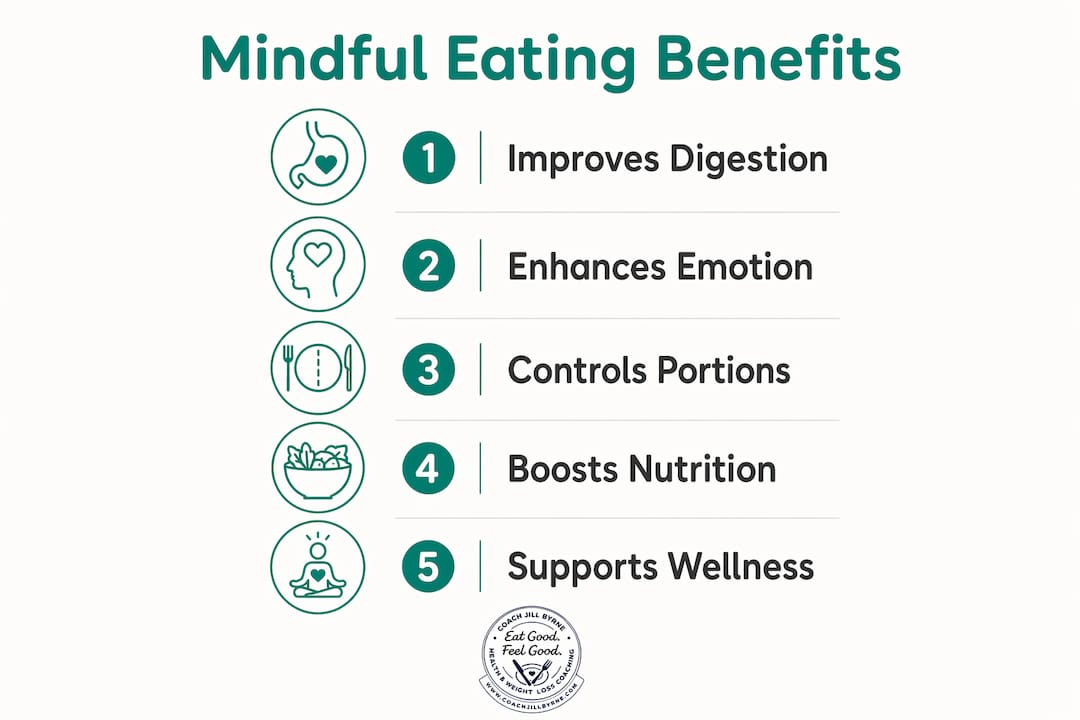
Mindful eating also directly reduces emotional and binge eating. When you observe your emotional state without judgment, you break the automatic cycle of reaching for food as a coping tool. This is one of the most significant long-term benefits for people working on weight management.
Here is what consistent mindful eating practice delivers:
Improved satiety signals. Eating slowly gives your brain the 15–20 minutes it needs to register fullness, which naturally reduces portion sizes without counting calories.
Reduced binge eating episodes. Non-judgmental awareness interrupts the shame-restrict-binge cycle that drives many eating disorders and weight struggles.
Better nutritional choices. When you pay attention to how food makes you feel, you naturally gravitate toward foods that provide sustained energy rather than quick spikes.
Lower food-related guilt. Mindful eating reframes meals as neutral experiences rather than moral tests, which reduces anxiety around eating.
Sustained weight control. Because mindful eating addresses the behavioral roots of overeating, its effects on weight are more durable than calorie-restriction approaches alone.
Greater meal satisfaction. Paying attention to taste, texture, and aroma increases enjoyment, which means you feel more satisfied with less food.
The impact of mindful eating on emotional health is especially significant for people who have spent years in a cycle of restrictive dieting. Removing the judgment from eating creates space for a genuinely healthier relationship with food.
How can you practice mindful eating effectively?
Practical mindful eating techniques do not require meditation retreats or major lifestyle overhauls. The most effective approach is to start with one meal per day and build from there. Experts recommend committing to 20 minutes for one focused meal daily. That duration gives your satiety hormones enough time to signal fullness before you have overeaten.
Here is a step-by-step approach that works for real life:
Set the environment first. Put your phone in another room or turn off the TV before you sit down. Environmental distractions are one of the biggest obstacles to mindful eating. Removing them is more effective than trying to stay focused while surrounded by screens.
Pause before the first bite. Look at your food. Notice the colors, textures, and aromas. This brief sensory check-in shifts your attention from autopilot to awareness.
Eat slowly and chew thoroughly. Put your fork down between bites. Aim to chew each bite 20–30 times. This is not a rule to follow perfectly. It is a practice that builds awareness.
Check in halfway through. Stop at the midpoint of your meal and rate your hunger on a scale from 1 to 10. This habit trains you to recognize the difference between comfortable fullness and overeating.
Observe without judgment. If you notice you are eating fast or feeling anxious, simply acknowledge it. Curiosity, not perfection, is the goal of mindful eating practice.
Reflect after eating. Spend 60 seconds after your meal noticing how you feel physically and emotionally. This reflection reinforces the feedback loop that makes mindful eating a lasting habit.
Pro Tip: If a full mindful meal feels like too much to start, try just the first five minutes of one meal each day. Even one mindful moment daily builds real momentum over time.
Common beginner pitfalls include treating mindful eating as a diet, expecting immediate results, and giving up after an unmindful meal. None of those responses serve you. Mindful eating is a skill that develops gradually, the same way any other skill does. The goal is progress, not a perfect score at every meal.
For more practical strategies on building these habits into your daily routine, the guide on rebuilding healthy eating routines offers nine concrete approaches that pair well with mindful eating practice.
How mindful eating connects nutrition knowledge to lasting behavior
Most people know what healthy eating looks like. The gap is not knowledge. The gap is consistent behavior. Mindful eating closes that gap by acting as the practical mechanism between what you know and what you actually do.
Research confirms that mindful eating mediates the link between nutrition knowledge and sustainable healthy eating by boosting diet self-efficacy and self-regulation. Self-efficacy means your confidence in your ability to make good food choices. When mindful eating builds that confidence through repeated small wins, healthy behavior becomes self-reinforcing.
Without mindful eating | With mindful eating |
Nutrition knowledge stays theoretical | Knowledge translates into daily food choices |
Impulse eating overrides intentions | Self-regulation interrupts impulsive responses |
Motivation depends on willpower | Behavior is driven by awareness and habit |
Results are short-term | Patterns become sustainable over months and years |
The behavioral linkage here is direct. A person who knows that vegetables support health but still reaches for processed snacks under stress is experiencing the knowledge-behavior gap. Mindful eating strategies address the stress response itself, not just the food choice. That is why the importance of mindful eating extends well beyond nutrition science into behavioral psychology.
Creating a home environment that supports these habits also matters. The guide on building a healthy food culture at home addresses how your surroundings either reinforce or undermine the mindful eating habits you are building.
Key Takeaways
Mindful eating is the most evidence-backed behavioral tool for closing the gap between nutrition knowledge and consistent, sustainable food choices.
Point | Details |
Mindful eating predicts behavior | Research shows it explains 61.4%–74.6% of variance in sustainable food consumption. |
Brain-level impact | Mindful eating strengthens prefrontal regulation and decouples emotional triggers from hunger. |
Start with one meal | Committing to 20 focused minutes at one daily meal builds satiety awareness and lasting habit. |
Environment shapes success | Removing phones and screens before meals is more effective than forcing focus amid distractions. |
Knowledge alone is not enough | Mindful eating mediates the link between what you know and what you consistently do. |
What I have learned coaching mindful eating in real life
The biggest misconception I see is that mindful eating is a diet. People come to me expecting a set of rules. What they actually need is a different relationship with their own attention. That shift takes time, and it looks different for every person.
What I have found is that the clients who make the most progress are not the ones who eat mindfully at every meal. They are the ones who practice without judgment when they do not. One distracted lunch does not erase a week of awareness. Treating every meal as a fresh start is the mindset that actually builds momentum.
Small environmental changes produce outsized results. Moving your phone off the table, eating at an actual table instead of a couch, or simply plating your food before eating rather than eating from the container. These are not dramatic changes. They are the kind of simple adjustments that make mindful practice possible without requiring enormous willpower.
The goal I set with every client is not perfection. It is curiosity. When you approach your eating with genuine curiosity about how food makes you feel, you start gathering real data about your own body. That data is more useful than any meal plan I could hand you.
— Coach Jill
Personalized support for building mindful eating habits
Knowing the principles of mindful eating is one thing. Applying them consistently in a busy life is another. Coachjillbyrne offers personalized mindful nutrition coaching that helps you move from awareness to consistent practice, with structured accountability built in at every step.

Coachjillbyrne’s programs are built around real food, practical habits, and the kind of support that keeps you on track when motivation dips. Whether you are working on weight management, emotional eating, or simply building a healthier relationship with food, the coaching approach is grounded in what actually works for real people in real life. Visit Coachjillbyrne to learn more about available programs and find the right fit for your goals.
FAQ
What is the role of mindful eating habits in weight loss?
Mindful eating supports weight loss by improving satiety awareness, reducing emotional eating, and helping you recognize fullness before overeating. It addresses the behavioral roots of weight gain rather than relying on calorie restriction alone.
How long does it take to develop mindful eating habits?
Mindful eating is a skill built gradually over time, not a switch you flip. Starting with one focused 20-minute meal per day creates consistent progress without overwhelming your routine.
Can mindful eating replace a structured diet plan?
Mindful eating is not a diet. It works best alongside a balanced nutrition approach by improving your awareness of hunger cues, food satisfaction, and emotional triggers that drive poor choices.
Why does eating environment matter for mindful eating?
Removing distractions like phones and screens before meals is one of the most effective ways to support mindful practice. Environmental cues strongly influence whether awareness or autopilot controls your eating.
Does mindful eating help with emotional eating?
Mindful eating directly reduces emotional eating by strengthening the brain’s prefrontal regulation pathways. It teaches you to observe emotional triggers without automatically responding to them with food.
Recommended
Comments