
How to Choose a Weight Loss Nutritionist That Works

If you want personalized, sustainable weight loss, the fastest, sensible next step is to book a consultation with a credentialed Registered Dietitian (RD or RDN) who provides Medical Nutrition Therapy, or to connect with a habit-based nutrition coach like Coachjillbyrne. Generic advice and fad diets rarely produce lasting results because they ignore your labs, your medications, and your actual daily life. A qualified weight loss nutritionist builds a plan around all three.
Before your first appointment, gather these items:
Your current medications list, including any GLP-1 prescriptions (Ozempic, Wegovy, Mounjaro)
Recent lab results (blood glucose, lipid panel, thyroid, vitamin D if available)
A 3-day food log reflecting your typical eating pattern
Your recent weight history and any measurements you track
Two or three specific goals you want to address in the first session
Ready to get started? Coachjillbyrne offers personalized nutrition coaching and habit-based weight loss programs you can book directly online.
Table of Contents
How a nutritionist helps you lose weight — real benefits vs. fad diets
What to expect at your first visit and throughout the program
How to choose the right nutritionist — a practical checklist
Client success snapshots: what habit change actually looks like
Why habit-based, real-food coaching produces lasting results
Coachjillbyrne: personalized nutrition coaching for real, lasting results
What does a weight loss nutritionist actually do?
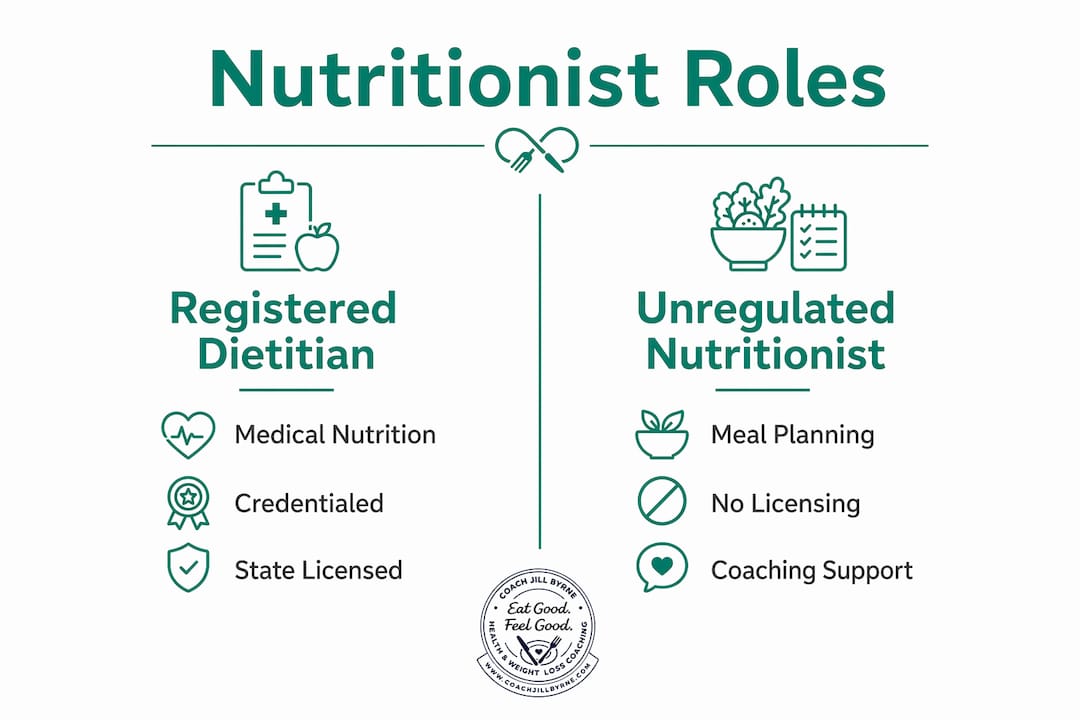
The title “nutritionist” is not legally protected in most U.S. states, which means anyone can use it. A Registered Dietitian or Registered Dietitian Nutritionist, on the other hand, completes an accredited bachelor’s or graduate degree, a minimum of 1,200 hours of supervised clinical training, and a national board examination before practicing, according to the Bureau of Labor Statistics. That credential qualifies them to provide Medical Nutrition Therapy.

Medical Nutrition Therapy (MNT) is a clinical service that uses individualized nutrition assessment and intervention to treat or manage a medical condition, including obesity. It goes well beyond a generic meal plan. An RD providing MNT can interpret your lab work, coordinate directly with your physician or prescriber, adjust your plan as your health markers change, and document care in a way that may qualify for insurance reimbursement.

Scope of Practice | Registered Dietitian (RD/RDN) | Unregulated “Nutritionist” |
Provide Medical Nutrition Therapy | Yes | No |
Interpret lab results clinically | Yes | No |
Coordinate with prescribers | Yes | Limited |
Create individualized meal plans | Yes | Yes |
Behavior-change coaching | Yes | Yes |
State licensure required | Yes (most states) | Varies |
Pro Tip: Verify any nutrition professional’s RD or RDN credential at the Commission on Dietetic Registration’s online directory before booking. Also confirm state licensure if you are working in person, since requirements differ by state.
A habit-based nutrition coach who is not an RD can still provide meaningful support for meal planning, accountability, and behavior change, which is exactly the model Coachjillbyrne uses. The distinction matters most when you have a medical condition requiring clinical oversight or lab-driven adjustments.
How a nutritionist helps you lose weight — real benefits vs. fad diets
Fad diets work by creating a temporary calorie deficit through restriction. They rarely account for your metabolic rate, your food preferences, your schedule, or your relationship with food. A credentialed nutritionist for weight loss builds a plan that does all of that, which is why the outcomes tend to last longer.
Concrete benefits clients typically see include:
Personalized calorie and macronutrient targets based on body composition, activity level, and metabolic health, not a generic formula
Lab-driven adjustments that catch issues like low iron or thyroid dysfunction that stall weight loss
Behavior-change coaching that addresses emotional eating, portion distortion, and meal timing
Structured accountability through regular check-ins that keep clients on track between sessions
Relapse prevention planning so that a bad week does not erase months of progress
Coordination with your medical team when medications or conditions require it
Safe weight-loss rate: Johns Hopkins Medicine cites approximately 1 to 1.5 pounds per week as the clinically recommended target for sustainable fat loss through MNT. Faster rates typically involve muscle loss and metabolic adaptation that make long-term maintenance harder.
The sustainable weight loss approach Coachjillbyrne uses centers on real-food strategies and habit consolidation rather than short-term restriction, which aligns directly with this clinical guidance.
What to expect at your first visit and throughout the program
The intake appointment
A thorough intake typically runs 60–90 minutes. Your nutritionist will review your full health history, current medications (including any GLP-1 use), recent labs, and a food recall covering your typical eating patterns. From there, they set measurable goals and establish a baseline using weight, waist circumference, and relevant lab markers. Preparing a 3-day food log before this visit gives your nutritionist a realistic starting point rather than a best-guess estimate.
Program structure and visit cadence
Most structured weight-loss programs run 3–6 months for meaningful, measurable change. A common cadence looks like this:
Phase | Timing | Focus |
Stabilization | — | Baseline habits, reducing ultra-processed foods, building consistency |
Active loss | Weeks 4–12 | Measurable weight reduction, behavior reinforcement, lab check-in |
Habit consolidation | Months 3–6 | Locking in sustainable patterns, adjusting targets |
Maintenance planning | Month 6+ | Long-term strategy, relapse prevention, reduced check-in frequency |
Follow-up visits are typically weekly or biweekly during active phases, then monthly once habits are stable. Telehealth-based programs that include messaging access between sessions tend to reduce early dropout by making follow-up simpler for busy clients.
Setting realistic weight loss goals from the start, with specific and measurable targets, keeps motivation grounded in progress rather than perfection.
How to choose the right nutritionist — a practical checklist
Credentials and experience to verify
RD or RDN credential — confirm via the Commission on Dietetic Registration
State licensure — required in most states for clinical nutrition practice
MNT experience — ask specifically about weight management cases, not just general nutrition
GLP-1 or medication experience — increasingly relevant given how many clients are on weight-loss medications
Telehealth availability — virtual nutrition coaching expands access and simplifies follow-up
Insurance and reimbursement options — some plans cover MNT when ordered for qualifying conditions; verify directly with your insurer since coverage varies significantly
Questions to ask before you hire
How do you measure progress beyond the scale?
Do you coordinate with my prescriber if I am on a weight-loss medication?
What happens if I need to cancel or pause the program?
How do you handle a weight-loss plateau?
What does a typical follow-up session look like?
Pricing expectations
Nutrition coaching programs vary widely. Single sessions with an RD typically run $100–$250 depending on location and specialty. Monthly packages that include multiple sessions, meal planning, and messaging access are common and often more cost-effective for clients committing to a 3–6 month program. Watch for additional fees for lab review, custom meal plans, or unlimited messaging that are not included in the base rate.
Red flags to avoid
Guarantees of a specific amount of weight loss in a fixed timeframe
Plans that eliminate entire food groups without a clinical reason
No pathway to refer you back to a physician if a medical issue arises
Inability or unwillingness to verify credentials
Pressure to purchase supplements or proprietary products as part of the program
How nutritionists support clients on GLP-1 medications
GLP-1 receptor agonists like semaglutide (Ozempic, Wegovy) and tirzepatide (Mounjaro, Zepbound) significantly reduce appetite, which changes the nutrition picture in ways that require active management. A nutritionist working with clients on these medications does more than adjust calories.
Key nutrition priorities for clients on GLP-1s include:
Protein prioritization to preserve lean muscle mass during rapid weight loss
Nutrient-dense meal patterns that deliver adequate vitamins and minerals in smaller volumes
Structured eating windows to manage nausea common during dose escalation
Hydration monitoring since reduced intake can lead to dehydration
Your nutritionist should also coordinate with your prescribing provider. If you experience significant nausea, vomiting, or signs of malnutrition, that information needs to reach your prescriber promptly. Dose timing, escalation schedules, and side-effect patterns all affect what and how much you can eat on any given day. Coachjillbyrne’s real food guidance for GLP-1 users addresses exactly these practical adjustments.
A critical safety note: Clients with a history of disordered eating or eating disorders require careful screening before starting any weight-focused intervention, including GLP-1 therapy. If disordered eating patterns emerge during treatment, a referral to a mental health professional with eating disorder expertise takes priority over continued weight-loss coaching.
Pro Tip: Track four things weekly while on a GLP-1: total daily protein intake, fluid intake, any GI symptoms, and your weight. Bring this log to every check-in so your nutritionist and prescriber can make informed adjustments.
Client success snapshots: what habit change actually looks like
Real progress in nutrition coaching rarely comes from a single dramatic overhaul. It comes from a handful of targeted habit changes, applied consistently over months. The following snapshots reflect the kinds of changes and timelines clients typically experience.
Client A came in eating most calories after 7 PM and skipping breakfast. The primary change: a structured morning meal with 30 grams of protein. Within 8 weeks, evening cravings dropped noticeably, and weight began moving consistently.
Client B was drinking two to three sweetened beverages daily, adding several hundred calories without any satiety benefit. Replacing those with water and one unsweetened coffee reduced weekly caloric intake meaningfully, with no change to solid food. Weight loss began within the first month.
Client C started a GLP-1 medication and was eating so little that protein intake fell below 60 grams per day. After restructuring meals around sustainable weight loss foods and adding a protein-focused snack, energy levels improved and muscle loss slowed.
Client D had lost weight before but always regained it. The focus shifted from weight loss to weight loss maintenance, building the specific habits that prevent regain: consistent meal timing, weekly weigh-ins, and a clear plan for high-stress periods.
The habit changes that consistently produce the biggest results: protein at every meal, reduced liquid calories, consistent sleep, and a structured check-in routine with a coach.
Pro Tip: After early success, the most common mistake is reducing check-in frequency too soon. Keep monthly accountability sessions in place for at least six months after reaching your goal weight. The research on long-term weight management consistently shows that ongoing contact with a coach or clinician is one of the strongest predictors of sustained results.
How to get started with a weight loss nutritionist
Pre-visit preparation checklist
Pull together your current medications list, including dosage and frequency
Locate your most recent lab results (within the past 12 months if possible)
Complete a 3-day food log before your intake appointment
Note your current weight and any measurements you track
Write down two to three specific goals you want to address
What to expect during booking
Most nutrition coaching programs, including Coachjillbyrne’s, begin with an intake form or brief discovery call to confirm fit before the first full session. You will typically complete health history paperwork and a food questionnaire before the appointment itself. This preparation makes the first session more productive and focused on your actual situation rather than basic data collection.
Pro Tip: Do not clean up your food log before submitting it. An accurate 3-day record of what you actually eat, not what you wish you ate, gives your nutritionist the real baseline they need to build a plan that fits your life.
Book your first session directly at Coachjillbyrne.com to get started with a personalized program.
Key Takeaways
Working with a credentialed weight loss nutritionist who provides Medical Nutrition Therapy and habit-based coaching gives you the personalized, medically informed foundation that fad diets and generic plans cannot replicate.
Point | Details |
Credential verification | Confirm RD or RDN status and state licensure before booking any nutrition professional. |
Safe weight-loss rate | Clinical guidance targets approximately 1 to 1.5 pounds of fat loss per week, as recommended by Johns Hopkins Medicine for sustainable results. |
Program timeline | Plan for 3–6 months of structured coaching to build habits that last beyond the program. |
GLP-1 coordination | If you are on a weight-loss medication, your nutritionist should coordinate actively with your prescriber. |
Coachjillbyrne | Offers habit-based, real-food nutrition coaching including GLP-1 support and personalized meal planning. |
Why habit-based, real-food coaching produces lasting results
The most durable weight-loss outcomes come not from the most aggressive calorie cuts, but from the smallest habit changes applied with the most consistency. Eliminating one high-calorie beverage, adding protein to breakfast, and checking in weekly with a coach may sound modest. Over six months, those changes compound into measurable, sustainable results that a crash diet rarely produces.
The evidence supports this framing. Research on behavioral interventions for weight management consistently shows that structured support, regular contact, and individualized plans outperform self-directed approaches over the medium and long term. Coachjillbyrne’s approach integrates these evidence-based principles with practical, real-food coaching that fits into everyday life rather than a controlled clinical setting.
The difference between what most weight-loss programs promise and what they deliver ultimately comes down to one thing: personalization. A plan built around your labs, your schedule, your food preferences, and your medical history is simply more likely to work than one based on a population average. This is not just a philosophical position; it is what the clinical literature on MNT and behavior change consistently demonstrates.
Coachjillbyrne: personalized nutrition coaching for real, lasting results
Most people who search for a weight loss nutritionist are not looking for another generic meal plan. They want a structured, personalized program with real accountability and a clear path forward. That is precisely what Coachjillbyrne delivers.

Coachjillbyrne’s coaching programs include personalized meal planning built around real food, habit-based coaching focused on practical daily changes, GLP-1 nutrition support for clients on weight-loss medications, and consistent accountability through regular check-ins. Programs are available as monthly packages or individual sessions, and telehealth delivery means you can access coaching regardless of where you live. Insurance reimbursement for nutrition coaching varies by plan; Coachjillbyrne can help you understand your options.
Ready to build a plan that fits your actual life? Book your first session at Coachjillbyrne.com and come prepared with your food log, your labs, and your goals.
This article is general information, not medical or dietary advice. Consult a qualified healthcare professional or Registered Dietitian for guidance specific to your health situation.
Useful sources and further reading
Bureau of Labor Statistics — Dietitians and Nutritionists
Johns Hopkins Medicine — Medical Nutrition Therapy for Weight Loss
PubMed — Behavioral interventions for weight management
PubMed — Nutrition counseling and weight outcomes
Coachjillbyrne — How to start weight loss without restrictive dieting
Coachjillbyrne — Sustainable weight loss explained
Coachjillbyrne — Real food guidance for GLP-1 users
Coachjillbyrne — Realistic weight loss goal examples
FAQ
Can a nutritionist actually help you lose weight?
Yes. Working with a credentialed nutritionist or Registered Dietitian for weight loss provides personalized calorie targets, behavior-change coaching, and accountability that self-directed approaches typically lack, producing more consistent and sustainable results.
What is the safe rate of weight loss with a nutritionist?
Johns Hopkins Medicine cites approximately 1 to 1.5 pounds per week as the clinically recommended target, which preserves muscle mass and supports long-term maintenance better than faster approaches.
What is the 30-30-30 rule for weight loss?
The 30-30-30 approach refers to consuming 30 grams of protein within 30 minutes of waking and following it with 30 minutes of low-intensity movement. It is a popular habit framework, not a clinical protocol, and its effectiveness depends on how well it fits an individual’s overall nutrition plan.
How long does a weight loss nutrition program typically take?
Most structured programs run several months to allow for meaningful habit consolidation and measurable fat loss, followed by a maintenance phase with reduced check-in frequency to support long-term results.
Does Coachjillbyrne offer support for clients on GLP-1 medications?
Yes. Coachjillbyrne provides GLP-1 nutrition support that addresses appetite changes, protein prioritization, and coordination with prescribers, helping clients on medications like semaglutide get the most from their treatment.
Recommended
Comments