
Whole Food Eating Principles for Lasting Health

Whole food eating principles are defined as a set of nutrition guidelines centered on choosing foods that remain close to their natural state, with most of your diet coming from fruits, vegetables, whole grains, nuts, legumes, plain dairy, and unprocessed meats or fish. The British Heart Foundation confirms there is no single official definition, but the core examples are consistent: minimally processed foods form the foundation, while ready meals, processed meats, and products loaded with added sugars, salt, or artificial additives are limited. The U.S. Dietary Guidelines 2025-2030 reinforce this through the Eat Real Food framework, recommending three servings of vegetables, two servings of fruit, and two to four servings of whole grains daily. Understanding these principles gives you a practical, evidence-based framework for improving health, managing weight, and building sustainable nutrition habits without resorting to restrictive dieting. For a broader look at how this connects to long-term wellness, real food nutrition offers a strong starting point.
What are whole food eating principles and how are they defined?
Whole food eating principles, also referred to in nutrition science as a minimally processed dietary pattern, direct you to prioritize foods that have undergone little to no industrial transformation. The focus is on food integrity: the closer a food is to how it grew or was raised, the more it aligns with these principles. This does not mean every item on your plate must be harvested that morning. It means the majority of your choices come from recognizable, single-ingredient, or lightly prepared sources.
The NOVA food classification system, developed by researchers at the University of São Paulo, provides the clearest framework for understanding food processing levels. NOVA divides foods into four groups: unprocessed or minimally processed foods, processed culinary ingredients, processed foods, and ultra-processed foods. Minimally processed foods include fresh and frozen fruits and vegetables, plain milk and yogurt, coffee, tea, and eggs. Ultra-processed foods include packaged snacks, flavored cereals, fast food, and most ready-to-eat meals.
A practical principle of the whole food diet is that minimally processed options, such as frozen spinach, canned tomatoes without added salt, or pasteurized plain yogurt, still qualify. The processing involved in washing, cutting, freezing, or pasteurizing does not compromise nutritional integrity when no additional ingredients are introduced. This distinction matters because it makes whole food eating realistic for busy households.

Processing Level | Examples | Whole Food Aligned? |
Unprocessed | Fresh fruit, raw vegetables, plain meat | Yes |
Minimally processed | Frozen vegetables, plain yogurt, boiled eggs | Yes |
Processed | Canned beans with salt, cheese, smoked fish | Sometimes |
Ultra-processed | Packaged snacks, flavored cereals, fast food | No |
What are the health and weight management benefits of whole food eating?
The benefits of whole food eating extend well beyond basic nutrition. A 2026 reanalysis found that participants on fully unprocessed diets consumed approximately 57% more food by weight but around 330 fewer calories daily compared to those eating ultra-processed diets. That finding reframes weight management entirely: you can eat more volume and still reduce calorie intake, simply by shifting toward whole foods.
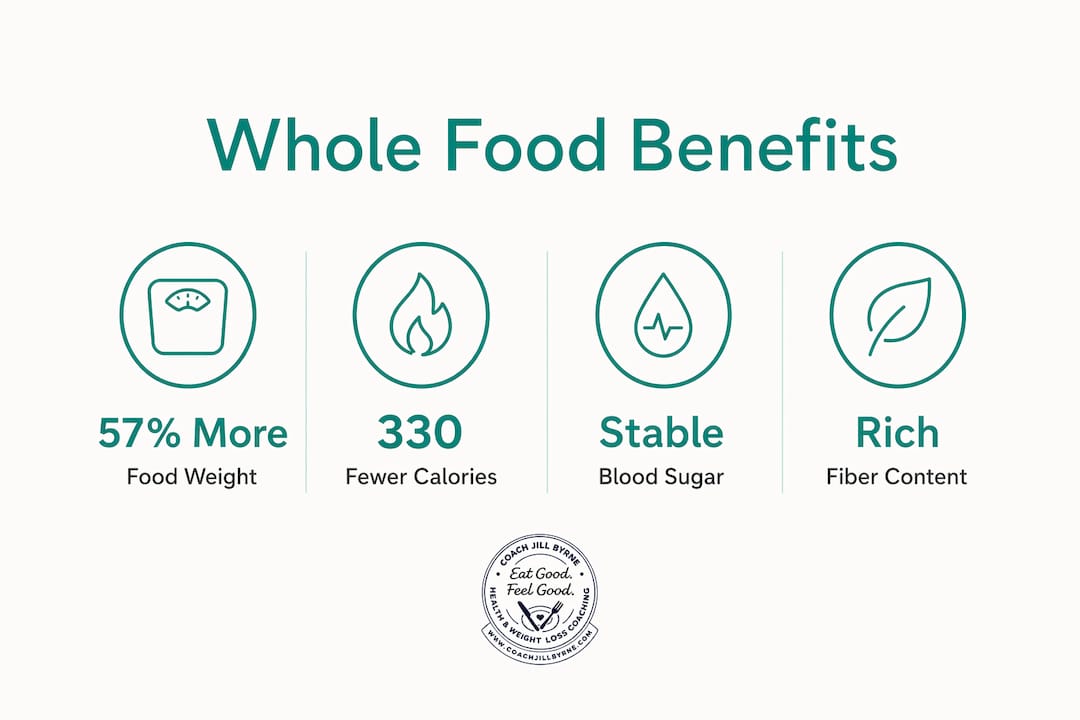
The mechanism behind this is fiber and water content. Whole foods are naturally high in both, which slows digestion, promotes fullness, and reduces the urge to overeat. This is why sustainable weight loss foods consistently feature vegetables, legumes, and whole grains rather than calorie-dense processed alternatives. You do not need to count calories when the food itself regulates appetite.
Research also suggests people develop a form of nutritional intelligence on unprocessed diets. According to Bristol BRC findings, individuals naturally select higher-micronutrient foods like spinach and carrots over calorie-dense ultra-processed options when eating whole food patterns. This internal calibration supports nutrient balance without deliberate tracking.
“Higher satiety on whole-food diets comes from fiber and water content, leading to a natural reduction in calorie intake and helping weight management without calorie counting.” — Bristol BRC Research
The metabolic benefits are equally significant. Whole food nutrition guidelines support more stable blood sugar levels because fiber slows glucose absorption. Diets rich in whole grains, legumes, and vegetables are associated with improved cholesterol profiles and better digestive health. These outcomes compound over time, making whole food eating one of the most evidence-supported approaches to long-term health.
How to apply whole food eating principles practically in daily life
Applying whole food nutrition guidelines does not require perfection. The British Heart Foundation explicitly recommends a balance over all-or-nothing approach because strict exclusion of all processed foods leads to burnout and reduced dietary variety. A practical model is the 80/20 ratio: aim for 80% of your meals to come from whole or minimally processed sources, and allow 20% flexibility for convenience or social eating.
Here is a practical framework for getting started:
Audit your current plate. Identify which items are ultra-processed and which are already whole or minimally processed. Most people find they already eat more whole foods than they realize.
Make direct swaps. Replace fruit juice with whole fruit. Swap flavored yogurt for plain yogurt with fresh berries. Choose oats over packaged breakfast cereals.
Build a whole food shopping list. Stock your kitchen with fresh or frozen vegetables, whole grains like brown rice and quinoa, legumes, eggs, plain dairy, and unprocessed proteins.
Prep in batches. Cook a large pot of lentils or brown rice at the start of the week. Wash and chop vegetables in advance. Preparation reduces the friction that pushes people toward ultra-processed convenience foods.
Use minimally processed backups strategically. Reduced-salt canned beans, frozen edamame, and plain Greek yogurt are all consistent with whole food principles and save time without sacrificing nutrition quality.
Pro Tip: When reading a food label, a short ingredient list with recognizable items is a reliable indicator that a product aligns with whole food principles. If you cannot identify most ingredients, it likely falls into the ultra-processed category.
The bimi app offers a practical tool for identifying food processing levels in everyday products, which can simplify the transition for those new to whole food eating. Meal planning is the single most effective habit for maintaining these principles consistently. When you know what you are eating before hunger strikes, you make better choices by default.
How does food processing affect nutrient absorption and calorie impact?
Food structure, not just nutrient content, determines how your body processes what you eat. This is one of the most underappreciated aspects of whole food nutrition. The physical integrity of a food affects digestion speed, fat availability, and glucose absorption in ways that go beyond what a nutrition label can capture.
Consider almonds as a concrete example. Whole almonds have intact cell walls that physically limit how much fat your body can extract during digestion. Ground almonds release more fat for absorption because the cell walls are broken down before you eat them. The calorie count on the package may be identical, but the metabolic outcome differs. This principle applies across many foods.
The same logic applies to sugar absorption. Whole fruit contains fiber that slows glucose release into the bloodstream, producing a gradual energy curve. Fruit juice removes that fiber, causing faster glucose absorption and a sharper insulin response. Both contain similar amounts of natural sugar, but the whole food version produces a fundamentally different metabolic effect.
Food Form | Digestion Speed | Calorie Availability | Blood Sugar Impact |
Whole almonds | Slow | Lower | Minimal |
Ground almonds | Faster | Higher | Moderate |
Whole fruit | Slow | Moderate | Gradual |
Fruit juice | Fast | Moderate | Sharp spike |
Whole grains | Slow | Moderate | Stable |
Refined grains | Fast | Higher | Rapid rise |
Fiber plays a central role in all of these outcomes. It slows gastric emptying, feeds beneficial gut bacteria, and reduces the glycemic impact of meals. Ultra-processed foods are typically low in fiber precisely because processing strips it away. This is why whole food nutrition produces measurably different health outcomes even when total calorie intake appears similar on paper.
Key takeaways
Whole food eating principles work because food structure, fiber content, and minimal processing together regulate appetite, nutrient absorption, and metabolic response in ways that calorie counting alone cannot replicate.
Point | Details |
Core definition | Whole food eating means choosing foods close to their natural state, prioritizing fruits, vegetables, whole grains, legumes, and unprocessed proteins. |
NOVA classification | The NOVA system identifies four processing levels; minimally processed foods like frozen vegetables and plain yogurt align with whole food principles. |
Satiety and weight | Unprocessed diets provide 57% more food by weight with roughly 330 fewer calories daily, supporting weight management without calorie counting. |
Food structure matters | Intact cell walls and fiber in whole foods slow fat and sugar absorption, producing better metabolic outcomes than processed equivalents. |
Flexibility is key | An 80/20 approach, mostly whole foods with some minimally processed options, supports long-term adherence better than strict exclusion. |
Why flexibility is the real foundation of whole food eating
I have worked with enough clients to know that the biggest obstacle to whole food eating is not knowledge. It is the belief that one imperfect meal undoes everything. That mindset is the actual problem, not the occasional bowl of pasta or the birthday cake at a party.
What I have observed consistently is that the clients who make the most lasting progress are not the ones who follow whole food principles with rigid precision. They are the ones who build a flexible, repeatable pattern. They keep frozen vegetables in the freezer for busy nights. They choose plain Greek yogurt over flavored versions most of the time, but they do not spiral when they do not. They understand that the spectrum of food choices is wide enough to accommodate real life.
The science supports this. Strict all-or-nothing diets consistently produce burnout and rebound. A balanced approach that incorporates mostly whole and minimally processed foods, while treating convenience items as occasional extras rather than moral failures, produces better long-term outcomes. That is not a compromise. That is the strategy.
What I find most compelling about the 2026 research from Bristol BRC is the concept of nutritional intelligence. When people eat more whole foods, they naturally gravitate toward higher-micronutrient, lower-calorie options without being told to. The body recalibrates. You do not have to white-knuckle your way through every meal. You build the habit, and the habit starts working for you.
My advice is to start with one meal a day. Make breakfast whole food focused for two weeks. Add lunch the following two weeks. Build the pattern gradually rather than overhauling everything at once. Sustainable change comes from consistent small decisions, not dramatic overhauls that fade by week three.
— Coach Jill
Start your whole food journey with Coach Jill Byrne

Knowing the principles is the first step. Applying them consistently in your own life, with your schedule, your preferences, and your goals, is where personalized support makes a measurable difference. Coachjillbyrne offers nutrition coaching built around real food habits, practical meal planning, and accountability structures that fit into everyday life rather than demanding you reshape it entirely. The coaching philosophy at Coachjillbyrne centers on sustainable dietary change, not short-term restriction. If you are ready to move from understanding whole food principles to living them, explore how individualized coaching can help you build a pattern that lasts.
FAQ
What are whole food eating principles in simple terms?
Whole food eating principles mean choosing foods that are close to their natural state, such as fruits, vegetables, whole grains, legumes, plain dairy, and unprocessed meats, while limiting ultra-processed products with added sugars, salt, or artificial additives.
Are frozen vegetables considered whole foods?
Yes. Frozen vegetables are classified as minimally processed under the NOVA system because freezing preserves nutritional integrity without adding ingredients. They are fully consistent with whole food nutrition guidelines.
How does whole food eating support weight management?
A 2026 reanalysis found that people on unprocessed diets ate 57% more food by weight but consumed roughly 330 fewer calories daily compared to ultra-processed diets. The fiber and water content in whole foods promotes fullness and reduces calorie intake naturally.
Do I need to avoid all processed foods to follow whole food principles?
No. The British Heart Foundation and nutrition experts recommend an 80/20 approach: 80% whole or minimally processed foods with 20% flexibility. Some processed foods like reduced-salt canned beans or plain yogurt fit within a whole food pattern.
What is the NOVA classification and why does it matter?
NOVA is a food classification system that divides foods into four processing levels, from unprocessed to ultra-processed. It provides a practical framework for identifying which foods align with whole food principles and which to limit, making it a useful tool for everyday food decisions.
Recommended
Comments