
How Joint Accountability Supports Wellness Goals

Joint accountability is defined as shared responsibility between two or more people working toward a common wellness outcome. Research confirms that how joint accountability supports wellness is measurable and significant. Making a commitment to another person raises the likelihood of completing a wellness goal to 65%. Adding a scheduled accountability appointment pushes that number to 95%. These figures come from behavioral research, not motivational theory. The standard industry term for this practice is mutual accountability, and it operates through two well-documented psychological forces: commitment consistency and social contagion.
How joint accountability supports wellness: the science behind it
The research on joint accountability in health is consistent and compelling. Group accountability increases habit success rates by 27% compared to solo attempts. That gap represents the difference between a habit that sticks and one that fades by week three.
The mechanism behind this improvement involves two psychological principles. Commitment consistency means people feel internal pressure to follow through once they have stated a goal to another person. Social contagion means that seeing peers make progress makes a goal feel more attainable rather than burdensome. Both forces work simultaneously when you share a wellness goal with someone you trust.
Specificity amplifies these effects considerably. When accountability partners specify when and where a wellness action will occur, follow-through increases by 91% compared to a general commitment. “I will exercise three times a week” produces far weaker results than “I will walk at Riverside Park every Tuesday, Thursday, and Saturday at 7 a.m. with my partner.” The difference is not motivation. The difference is structure.

The benefits of joint accountability also extend to goal calibration. When you observe a peer completing a 30-minute meal prep session or hitting a weekly step target, your own perception of what is achievable shifts upward. This social proof effect is one reason wellness through collaboration produces results that solo willpower rarely matches.
Key mechanisms that drive joint accountability outcomes:
Commitment consistency: Stating a goal publicly creates internal pressure to follow through
Social contagion: Peer progress recalibrates what feels possible for you
Implementation intentions: Naming the when and where of an action raises follow-through by 91%
Scheduled check-ins: Moving from a general partner commitment to a specific appointment raises success rates from 65% to 95%
What are the best formats for joint accountability in wellness?
Joint accountability in health takes several practical forms. Understanding which format fits your lifestyle determines whether the structure holds over time.
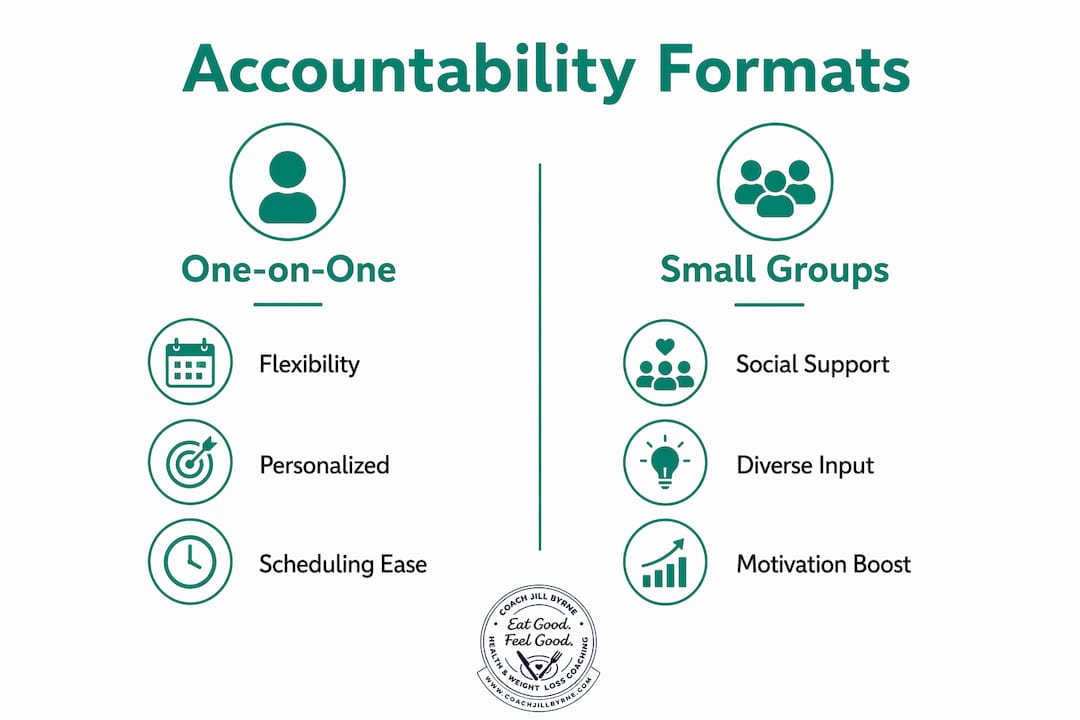
One-on-one partnerships vs. small groups
A dyadic partnership, meaning two people holding each other accountable, offers simplicity and scheduling flexibility. You coordinate with one person, set mutual expectations, and check in regularly. Small groups of three to six people introduce more social proof and peer modeling but require more coordination. Both formats work. The deciding factor is your schedule and how much social reinforcement you need to stay consistent.
Digital and in-person accountability partnerships are equally effective when check-in frequency and structure are maintained. This finding matters because it removes geography as a barrier. A weekly video call with a nutrition accountability partner in another city produces the same behavioral outcomes as a face-to-face meeting, provided the structure is consistent.
Format | Best for | Key advantage | Main challenge |
One-on-one partner | Flexible schedules | Easy coordination | Limited social proof |
Small group (3–6) | Social learners | Peer modeling effect | Scheduling complexity |
Digital community | Remote or busy individuals | Wide accessibility | Requires self-discipline to engage |
Coached accountability | Structured goal-setters | Expert guidance | Requires investment |
Choosing the right accountability partner
Partner selection determines the quality of the accountability relationship. The most effective partners share similar wellness behaviors and provide honest, direct feedback rather than empty encouragement. A partner who consistently validates missed workouts or skipped meal prep sessions reduces the accountability effect to near zero.
Weekly progress reports significantly improve habit consistency and completion rates. Groups using structured weekly updates see completion rates rise from 35% to 65–76%. That improvement comes from the reporting structure itself, not just the social connection.
Pro Tip: Choose a partner who is slightly ahead of you in their wellness progress. Research on social contagion shows that upward social comparison, observing someone who has already achieved what you are working toward, produces stronger motivation than comparing yourself to someone at the same level.
What psychological factors make joint accountability more effective?
The impact of accountability on well-being goes beyond simple motivation. The psychological dynamics inside an accountability relationship determine whether it produces growth or guilt.
The most important shift is moving from an individual mindset to a collective one. Effective joint accountability shifts focus from “my role” to “our outcome.” This distinction matters because it changes how setbacks are processed. When one partner misses a meal planning session, a shared-outcome mindset treats it as a problem the pair solves together. An individual-role mindset treats it as a personal failure, which increases shame and reduces the likelihood of returning to the habit.
“An effective joint accountability relationship emphasizes collective ownership instead of blame, which creates a safer environment to discuss barriers and setbacks honestly.”
Psychological safety is the term researchers use to describe this environment. When people feel safe disclosing a setback without fear of judgment, they are more likely to course-correct quickly rather than abandon the goal entirely. This is why the tone of check-in conversations matters as much as their frequency.
Common psychological pitfalls to avoid in accountability relationships:
Treating missed goals as moral failures rather than data points
Using check-ins to vent frustration rather than problem-solve
Allowing one partner to carry the emotional labor of the relationship
Skipping check-ins after a setback, which is exactly when they are most needed
Accountability also reduces decision fatigue by pre-deciding actions with a partner. When you and your accountability partner agree in advance that you will both prepare lunches on Sunday afternoons, you remove the daily decision of whether to do it. Pre-decided actions require less mental energy and are more likely to become automatic habits over time.
How do you apply joint accountability to personal wellness goals?
Applying joint responsibility for wellness requires a clear starting structure. The following steps move you from intention to a functioning accountability system.
Select your partner or group. Choose someone with compatible wellness goals and a similar level of commitment. Mismatched commitment levels are the most common reason accountability relationships dissolve within the first month.
Define specific commitments. Vague goals produce vague accountability. State exactly what you will do, when you will do it, and where. “I will prepare a balanced dinner at home on Monday, Wednesday, and Friday evenings” is a commitment your partner can hold you to. “I will eat better” is not.
Schedule your check-ins. Put them on the calendar as non-negotiable appointments. Scheduling a specific accountability appointment raises success rates to 95%. Treat the check-in with the same seriousness as a medical appointment.
Use objective data in your reports. Share measurable progress rather than feelings. “I completed four of five planned meals this week” gives your partner something concrete to respond to. Subjective reports like “I think I did okay” allow for progress fudging and reduce accountability integrity.
Adjust check-in frequency over time. Daily check-ins work best when a behavior is new. As the habit solidifies, taper to weekly. Maintaining daily check-ins for months creates fatigue and makes the structure feel like a burden rather than support.
Plan for setbacks in advance. Agree with your partner on how you will handle a missed week before it happens. Pre-planned recovery protocols prevent one bad week from becoming a permanent dropout.
Pro Tip: Start with the minimum viable accountability structure: tell one specific person one specific thing you will do, then follow up with them afterward. This simple interaction, described in behavioral research, is enough to meaningfully improve your follow-through before you build a more formal system.
Wellness activities particularly well-suited for joint accountability include meal planning, daily step targets, hydration tracking, sleep consistency, and sustainable weight loss habits. These behaviors are measurable, repeatable, and easy to report on objectively. They also benefit from the social proof effect because progress is visible and comparable between partners.
Key Takeaways
Joint accountability raises wellness goal completion rates from below 40% to as high as 95% when structured check-ins and specific commitments are combined.
Point | Details |
Commitment raises success to 65% | Telling one person your wellness goal more than doubles your baseline follow-through rate. |
Scheduled appointments reach 95% | Adding a specific accountability appointment to a partner commitment is the single highest-impact action you can take. |
Specificity drives follow-through | Naming the when and where of a wellness action increases follow-through by 91% over a general commitment. |
Shared-outcome mindset reduces shame | Framing setbacks as shared problems rather than personal failures keeps both partners engaged longer. |
Check-in frequency should evolve | Start with daily check-ins for new habits and taper to weekly as the behavior becomes routine. |
What I have learned from watching clients use accountability
After working with clients across a wide range of wellness goals, one pattern stands out clearly. The clients who make the most sustainable progress are almost never the ones with the strongest willpower. They are the ones with the strongest support structures.
I have seen clients lose significant weight and rebuild their relationship with food, not because they suddenly found discipline they lacked before, but because they stopped trying to do it alone. When you sync healthy eating habits with a partner, the goal shifts from something you are forcing yourself to do to something you are doing with someone. That shift changes everything about how you show up.
The mistake I see most often is treating accountability as a performance. Clients come to check-ins wanting to report only wins. They minimize setbacks or skip the check-in entirely after a hard week. This is the opposite of what the relationship is for. The check-in after a difficult week is the most valuable one you will have. That is when honest conversation produces the insight that actually moves the needle.
Mutual trust is not a soft benefit of accountability. It is the structural requirement. Without it, the relationship becomes a reporting exercise rather than a genuine support system. Build the trust first by being honest about your own struggles before you expect your partner to be honest about theirs.
Team accountability and wellness are not separate topics. They are the same topic. Sustainable lifestyle change is a collaborative process, and the research confirms what I observe in practice every day.
— Coach Jill
Ready to build your own accountability structure?
Coachjillbyrne is built on the principle that sustainable wellness requires structured support, not willpower alone. Every coaching program integrates the kind of consistent accountability that research shows drives real, lasting results.

If you are ready to move beyond solo attempts and build a wellness practice that holds over time, explore the coaching philosophy behind Coachjillbyrne’s approach. The programs are designed around habit-based nutrition coaching, personalized check-ins, and the shared-outcome mindset that makes accountability relationships work. Whether your goal is weight management, cleaner eating, or building consistent routines, the support structure is already in place.
FAQ
What is joint accountability in wellness?
Joint accountability in wellness is a shared commitment between two or more people to support each other’s health goals through regular check-ins and mutual responsibility. It is also called mutual accountability in behavioral research.
How much does an accountability partner improve success rates?
Committing to a partner raises goal completion to 65%, and scheduling a specific accountability appointment raises that figure to 95%, according to behavioral research on habit formation.
Does online accountability work as well as in-person?
Digital and in-person accountability partnerships produce equal results when check-in frequency and structure are maintained consistently. Geography is not the determining factor; structure is.
How often should accountability partners check in?
Daily check-ins work best when a behavior is new. As the habit becomes routine, tapering to weekly check-ins prevents fatigue while maintaining the support structure.
What makes an accountability relationship fail?
The most common causes of failure are vague commitments, skipping check-ins after setbacks, and treating the relationship as a performance rather than a genuine support system. Honest reporting and pre-planned recovery protocols prevent most breakdowns.
Recommended
Comments