
What Is the Food as Fuel Concept? A Clear Guide

Food as fuel is the idea that everything you eat supplies chemical energy your body converts into adenosine triphosphate (ATP), the molecule that powers every biological process you depend on. Think of ATP as the body’s universal energy currency: muscles contract with it, neurons fire with it, and organs function because of it. The three macronutrients that drive this process are carbohydrates, fats, and proteins, each delivering energy at different rates and concentrations.
Carbohydrates provide approximately 4 kcal per gram and serve as the body’s preferred, fastest-acting fuel source.
Fats deliver roughly 9 kcal per gram, making them the most energy-dense macronutrient and a critical source of sustained fuel.
Proteins also provide energy, though the body uses them primarily for tissue repair rather than immediate energy.
The brain alone accounts for approximately 20% of total body energy expenditure, underscoring why fuel quality matters beyond physical performance.
Understanding the nutritional fuel concept shifts how you think about eating. Food is not just a reward or a comfort mechanism. It is the raw material your body metabolizes to stay alive, focused, and physically capable.
Table of Contents
How macronutrients fuel your body’s energy systems
The body does not absorb food energy in one step. It runs it through a precise, multi-stage metabolic process before a single molecule of ATP is produced.
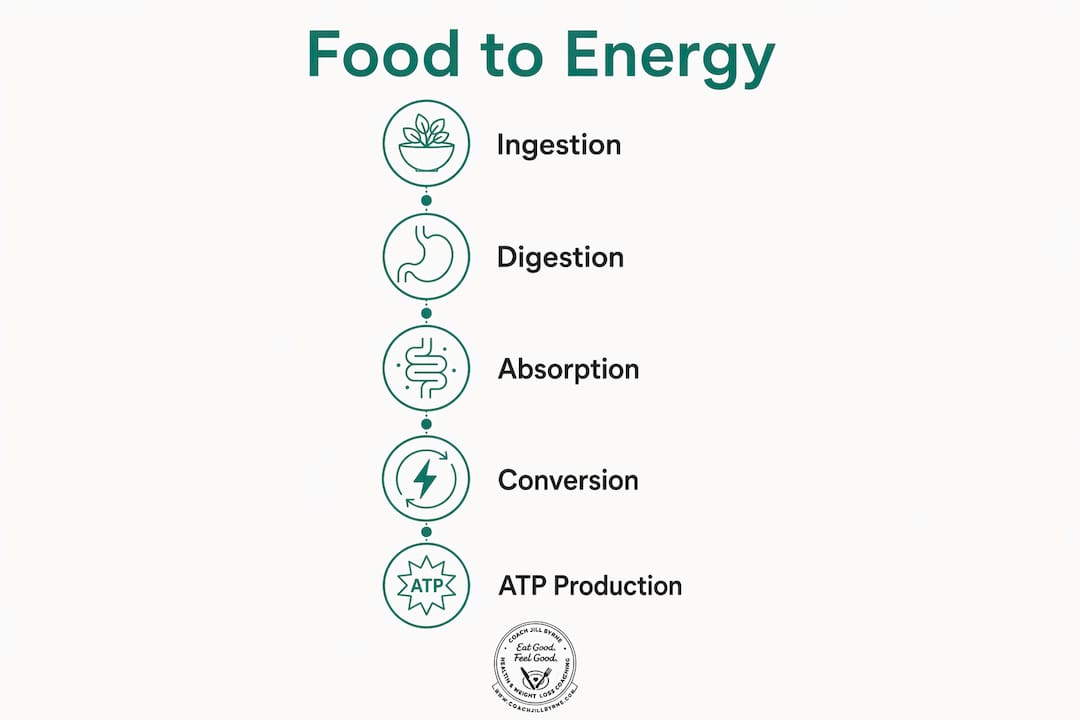
Digestion breaks down complex food into usable subunits: polysaccharides into simple sugars, proteins into amino acids, and fats into fatty acids and glycerol. Once those subunits enter the bloodstream and reach cells, the real energy conversion begins. Glycolysis converts glucose into pyruvate in the cytosol, generating a small initial yield of ATP and NADH. Pyruvate then moves into the mitochondria, where it enters the citric acid cycle, producing large quantities of NADH. Finally, oxidative phosphorylation on the inner mitochondrial membrane uses those electrons to generate the bulk of the cell’s ATP. Fatty acids follow a parallel route, broken down into acetyl-CoA and fed directly into the citric acid cycle.
Here is how each macronutrient contributes distinctively to this process:
Carbohydrates are the primary and most rapidly available fuel. Glucose from carbohydrates is the preferred substrate for glycolysis, making carbs the go-to source during high-intensity activity and for brain and muscle energy.
Fats provide concentrated, long-lasting energy at 9 kcal/g. Beyond fuel, dietary fats support hormone regulation and aid cognitive function, making them indispensable even for sedentary individuals.
Proteins contribute to energy production secondarily, typically when carbohydrate stores are depleted. Their primary role is muscle repair, immune support, and synthesis of enzymes and hormones.
Nearly half of the energy theoretically available from oxidizing glucose or fatty acids is captured as ATP, a conversion efficiency that outperforms a typical combustion engine by a significant margin.
Why viewing food as fuel matters for your health
The brain consumes approximately 20% of the body’s total energy despite representing only about 2% of body weight. That single fact reframes every meal: what you eat directly affects your capacity to think clearly, manage stress, and sustain focus throughout the day.
“Fueling involves strategic consumption to optimize energy production, physical performance, and overall well-being.” — University of Illinois Sports Nutrition
Energy expenditure encompasses basal metabolic rate, the thermic effect of food, and physical activity. When caloric intake consistently falls below expenditure, the body draws on stored glycogen and fat, eventually catabolizing muscle tissue. When intake chronically exceeds expenditure, excess energy is stored as fat. Balancing these two sides of the equation is the foundation of weight management.
Food quality, not just caloric quantity, determines how well that balance serves you. Nutrient-dense foods deliver vitamins, minerals, and fiber alongside their calories, supporting metabolic health in ways that processed, calorie-dense foods cannot. Choosing whole foods over highly processed alternatives directly affects sustained energy, hormonal balance, and long-term disease risk.
Physical performance depends on adequate carbohydrate stores and fat availability for endurance.
Mental clarity requires a steady glucose supply to the brain, best maintained through complex carbohydrates and balanced meals.
Metabolic health improves when nutrient density is prioritized alongside appropriate caloric intake.
Weight management becomes more sustainable when food choices support satiety and stable blood sugar rather than energy spikes and crashes.
Practical ways to apply the food as fuel mindset
The most common misapplication of the food as fuel concept is treating all calories as equivalent. A 300-calorie serving of oatmeal with berries and a 300-calorie bag of chips both register the same on a calorie counter, but they fuel the body in fundamentally different ways. Performance-focused eating can actually backfire when it leads people to consume high-calorie processed foods under the assumption that more energy input equals better output.
Proactive fueling means eating before energy runs low, not in response to hunger or fatigue. Waiting until you are exhausted to eat is the nutritional equivalent of letting a car run out of gas before stopping at a pump. Consuming nutrient-dense, easily digestible foods before energy slumps improves sustained mental and physical output more reliably than reactive eating.
Practical strategies for applying this mindset:
Build balanced meals around a lean protein, a complex carbohydrate, a healthy fat, and a vegetable at each sitting.
Swap refined grains for whole grains (white rice for brown rice, white bread for whole wheat) to extend energy release and improve fiber intake.
Choose whole food snacks such as nuts, Greek yogurt, or fruit over packaged options with added sugars and refined oils.
Time meals intentionally around physical activity: carbohydrate-rich foods before exercise, protein-rich foods after, to support both performance and recovery.
Read labels for nutrient density, not just calories. Prioritize foods with vitamins, minerals, and fiber relative to their caloric content.
Pro Tip: Before your next afternoon slump, swap a sugary snack for a small handful of almonds and a piece of fruit. The combination of healthy fat, fiber, and natural sugar provides a steadier energy release and supports focus for the next two to three hours.
Viewing food through the lens of real food nutrition simplifies decision-making. When the question shifts from “what do I want?” to “what does my body need to perform well right now?”, whole foods consistently win.
Expert insight from Coachjillbyrne on sustainable nutrition
Coachjillbyrne approaches the food as fuel concept not as a rigid dietary rule but as a practical framework for building lasting habits. The coaching model centers on mindful eating habits, portion awareness, and real food choices rather than calorie restriction or elimination diets.
“Effective nutrition coaching emphasizes habit building, portion control, and balanced real food choices aligned with the food as fuel mindset. Sustainable lifestyle changes, not restrictive diets, are what help clients improve energy and health over the long term.” — Coachjillbyrne
The practical pillars Coachjillbyrne applies with clients include:
Habit-based coaching that replaces reactive eating patterns with intentional, planned meals.
Portion control guidance that aligns food intake with individual energy needs without obsessive tracking.
Whole food prioritization that emphasizes nutrient density over caloric manipulation.
Accountability support that keeps clients consistent through the behavioral challenges that derail most nutrition plans.
Meal planning frameworks that make it easier to choose fuel-quality foods even on busy days.
Clients working with Coachjillbyrne report improved energy levels, more consistent weight management, and a clearer understanding of how their food choices affect daily performance. The coaching approach treats food as sustenance and as a tool for long-term wellness, not as a source of guilt or restriction.
How hydration interacts with food as fuel
Water does not provide calories, but it is indispensable to every step of the energy conversion process. Hydration supports digestion, nutrient transport, and body temperature regulation, all of which directly affect how efficiently the body converts food into usable energy.

Enzymes that break down carbohydrates, fats, and proteins require an aqueous environment to function. Dehydration slows gastric emptying, impairs nutrient absorption, and reduces blood volume, which limits oxygen and glucose delivery to working muscles and the brain. Even mild dehydration can blunt physical performance and cognitive function noticeably.
A practical rule: drink water consistently throughout the day rather than only when thirsty. Thirst is a lagging indicator of hydration status. Pairing adequate water intake with nutrient-dense meals creates the optimal internal environment for the food-to-ATP conversion chain to operate at full capacity.
The role of vitamins and minerals in energy metabolism
Macronutrients supply the raw energy, but vitamins and minerals act as the catalysts that make conversion possible. Without them, the metabolic pathways that produce ATP stall regardless of how much food you consume.

B vitamins, including thiamine (B1), riboflavin (B2), niacin (B3), pantothenic acid (B5), and B6, serve as coenzymes in glycolysis and the citric acid cycle. Iron is essential for oxygen transport via hemoglobin; without adequate iron, cells receive less oxygen and ATP production drops. Magnesium activates more than 300 enzymatic reactions, including several directly involved in ATP synthesis. Zinc supports protein metabolism and immune function, both of which affect overall energy availability.
Micronutrient deficiencies are one of the most overlooked reasons people feel chronically fatigued despite eating enough calories. Addressing food quality and nutrient density rather than focusing solely on caloric intake is what closes that gap. Whole foods, particularly leafy greens, legumes, nuts, seeds, and lean proteins, deliver these micronutrients in bioavailable forms that processed foods typically cannot replicate.
Coachjillbyrne helps you put food as fuel into practice
Understanding how food powers the body is one thing. Consistently applying that knowledge in everyday life, with real meals, real schedules, and real food preferences, is where most people need structured support.

Coachjillbyrne offers personalized nutrition coaching built around the food as fuel mindset: practical meal planning, portion guidance, and accountability that fits your actual lifestyle rather than an idealized version of it. There are no elimination diets, no unrealistic calorie targets, and no temporary fixes. The focus is on sustainable food quality choices that improve energy, support weight management, and build habits you can maintain long-term. Whether you are starting from scratch or refining an existing routine, Coachjillbyrne provides the guidance and accountability to make the shift from reactive eating to intentional fueling. Visit coachjillbyrne.com to learn more and take the first step toward a nutrition plan that works for your body and your goals.
Key Takeaways
Food as fuel means the body converts macronutrients into ATP through glycolysis and the citric acid cycle, powering every physical and mental function you rely on daily.
Point | Details |
ATP is the energy currency | Carbohydrates, fats, and proteins are all metabolized into ATP, the molecule that powers every cellular process. |
Brain demands 20% of energy | The brain consumes approximately 20% of total body energy, making fuel quality critical for mental performance. |
Nutrient density beats calorie counting | Whole foods deliver vitamins, minerals, and fiber that support metabolism in ways calorie-equivalent processed foods cannot. |
Hydration enables conversion | Water is required for digestion, nutrient transport, and enzymatic function; dehydration impairs the food-to-ATP process. |
Coachjillbyrne applies this framework | Personalized coaching from Coachjillbyrne translates the food as fuel concept into practical habits for lasting energy and weight management. |
FAQ
What does food as fuel mean?
Food as fuel means the body extracts chemical energy from macronutrients in food and converts it into ATP, the molecule that powers metabolic, physical, and cognitive functions. It is a framework for understanding why food quality and composition matter beyond simple caloric intake.
What are examples of fuel foods?
Complex carbohydrates like oats and brown rice, lean proteins like chicken and legumes, and healthy fats like avocado and nuts are all strong fuel foods. They provide sustained energy release and deliver the micronutrients needed to support the metabolic pathways that produce ATP.
Why do we say food is our fuel?
Food supplies the chemical energy the body cannot produce on its own, much like a vehicle requires an external fuel source to run. Without adequate macronutrients and micronutrients, the body cannot generate enough ATP to sustain basic metabolic functions, physical activity, or brain performance.
How long does it take the body to use food as fuel?
Simple carbohydrates begin entering the bloodstream relatively quickly after consumption, while complex carbohydrates, proteins, and fats take longer to digest and convert, providing energy over several hours. The full metabolic process from digestion to ATP production varies by food composition and individual metabolic rate.
Recommended
soi cầu xổ số miền bắc dạo này mình thấy bạn bè nhắc hoài nên cũng ghé thử cho biết. Mình không phải kiểu ngồi soi từng kèo, chủ yếu xem trang họ trình bày có dễ lướt không thôi. Vào cái là thấy họ ghi rõ bài theo ngày, kiểu “Soi cầu MB ngày 16 8 2026”, nên khỏi phải đoán đang nói ngày nào. Mình thích cái đoạn “Dự đoán XSMB hôm nay” đặt ngay chỗ dễ nhìn, kéo xuống là gặp, đọc lướt cũng hiểu họ đang tổng hợp gì. Nội dung chia thành mấy khối ngắn, tiêu đề to nên không bị rối mắt, nhất là mấy heading có ngày tháng hiện rõ trên từng mục.
Mình chơi xổ số kiểu cho vui là chính, coi như giải trí nên cũng không đặt nặng chuyện trúng đậm. Trước đây nghe người ta bàn tán về mấy “cầu” này nọ, mình cũng thử để ý xem có gì hay không. Theo dõi một thời gian thì thấy đôi lúc có vài chỗ lặp lại, nên mình bắt đầu ghi chú lại vài ý mỗi khi đọc nhận định, rồi chờ kết quả về để so xem có phải mình đang tự tưởng tượng ra quy luật không. Có hôm trúng được chút thì vui, nhưng cũng có ngày lệch hết nên mình luôn nhắc bản thân đừng quá hưng phấn và phải kiểm soát tiền. Thi thoảng…